
Grief & Bereavement
How Do You Grieve Someone Who Also Hurt You?
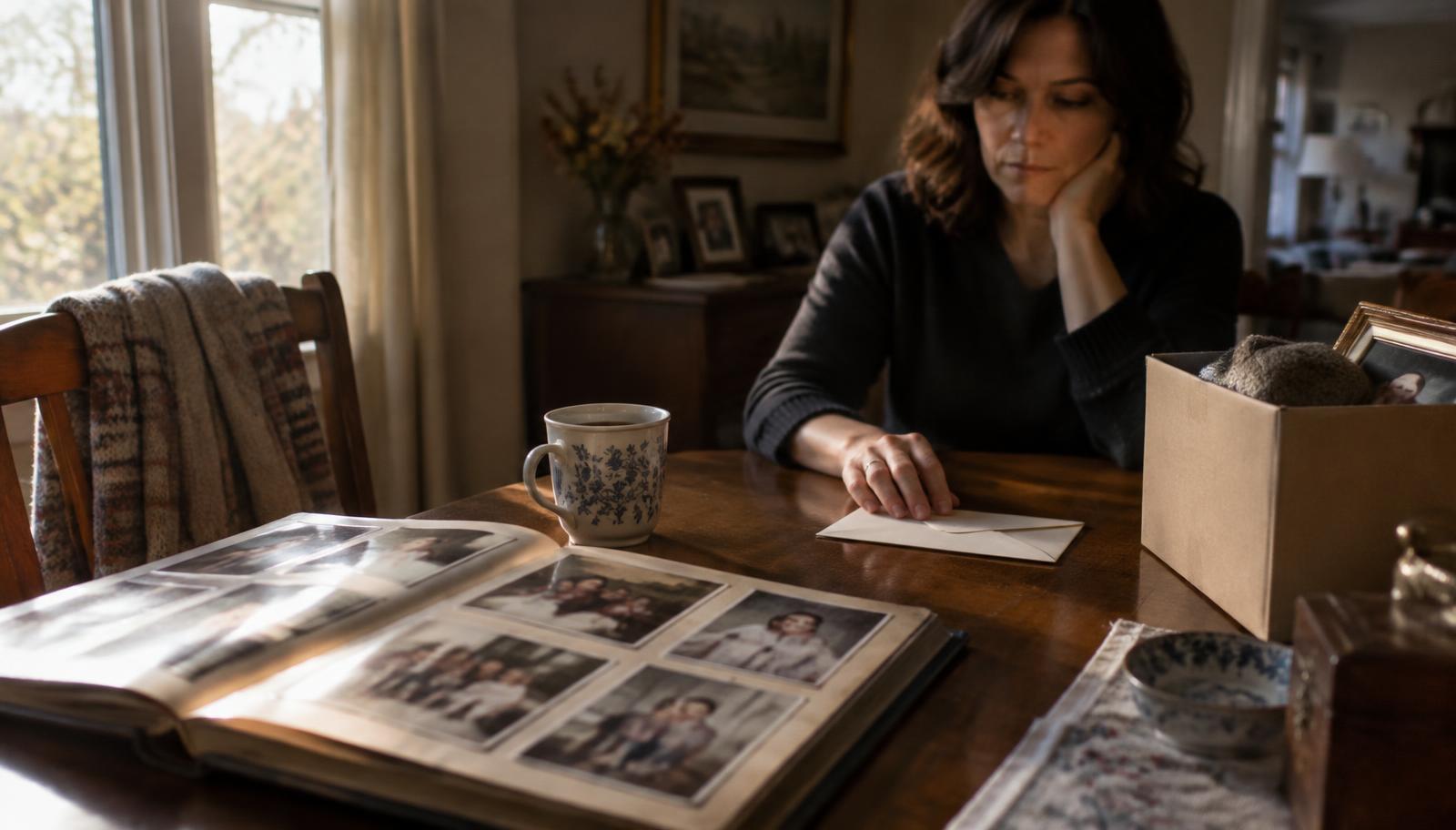
When death does not turn a complicated relationship into a simple one
Death has a way of editing people.
Photographs are chosen carefully. Stories become warmer. People remember the funny things that were said at Christmas, the sacrifices someone made, the meals they cooked, the way they showed up when somebody needed help. Funerals are rarely designed to hold the entire emotional complexity of a human relationship. They tend to gather the pieces that can be spoken aloud in a room full of grieving people.
That can become painfully disorienting when the person who died was also someone who hurt you.
Maybe there was love. Maybe there was resentment. Perhaps there were years when the relationship was good and years when it was almost unbearable. You may have spent a lifetime wanting something from this person that they could not or would not give. An apology. Protection. Honesty. Recognition. Accountability. Approval. A conversation that did not end with somebody leaving the room.
Then the person dies, and suddenly everyone speaks about them in the past tense as though death resolved what life never did.
It doesn't.
A complicated relationship can remain complicated after death.
Bereavement research has moved considerably beyond the older assumption that healthy grief requires severing an emotional bond with the deceased. A systematic review of 79 studies examining continuing bonds found something more nuanced: ongoing bonds after death can involve comfort and distress and are closely related to relational identity, memory, spirituality, and the way bereaved people continue making meaning of the relationship. The important point is not that continuing bonds are always helpful or always harmful. Their meaning depends partly on the relationship that is being continued internally.
That becomes especially relevant when the relationship contained unresolved conflict.
Recent longitudinal research on unfinished business in bereavement followed bereaved college students across three measurement periods. Unfinished business consistently predicted greater grief over time, while different forms of continuing bonds showed different relationships with later grief. The study involved a young, specific sample, so it should not be treated as a universal description of bereavement. Still, it contributes to a growing recognition that what remained unsaid or unresolved before death can matter afterward.
This is something people with conflicted grief often understand without needing the terminology.
Sometimes the death itself is not the only loss.
You lose the possibility that one day the relationship might become different.
As long as somebody is alive, there is at least an imagined future in which something changes. Maybe they finally understand. Maybe age softens them. Maybe you have the conversation differently. Maybe they acknowledge what happened. Maybe you stop waiting for the apology. Maybe you simply make peace with one another in a way neither of you has managed yet.
Death can close that imagined future without resolving it.
The finality is brutal because there will be no new evidence.
No corrected conversation.
No unexpected knock at the door.
No opportunity to say, “I need you to understand what that did to me.”
This is one reason grief can contain anger without making the grieving person cruel. Anger may not be evidence that love was absent. It may be evidence that the relationship mattered enough to disappoint.
Relief can be even harder to admit.
Some people feel relief after a difficult person dies. If the relationship involved chronic conflict, instability, caregiving strain, emotional abuse, addiction, fear, or years of anticipating the next crisis, death may end an exhausting psychological state. The nervous system recognizes the ending even while the heart recognizes the loss.
Then shame appears.
“What kind of person feels relieved?”
A human one.
Relief and grief are not mutually exclusive emotional verdicts. Neither feeling tells the entire story of the relationship. A person may miss someone's laugh while feeling grateful that the arguments are over. They may love the person and recognize that contact with them was painful. They may wish the deceased peace and still refuse to rewrite history simply because there can no longer be consequences for telling the truth.
This is where memorial language can become especially difficult.
People sometimes feel pressured to accept a version of the deceased that erases the relationship they actually lived. “They did the best they could.” Maybe they did. Maybe they did not. Most of the time, none of us has access to another person's full internal capacity. Trying to settle that question can become another form of unfinished business.
Perhaps the more useful question is not whether the deceased was ultimately good or bad.
It is whether you are willing to let the relationship be whole.
Whole relationships contain contradictions.
Someone can have loved you and failed you.
Someone can have sacrificed for you and wounded you.
Someone can have been deeply hurt in their own life and still remained responsible for the hurt they caused.
Someone can be missed without being idealized.
And someone can be forgiven without pretending the relationship was safe.
Forgiveness itself is not a requirement of bereavement. Death does not create an ethical deadline by which every injury must suddenly be released. Some people find forgiveness meaningful. Others find acceptance, distance, compassion, anger, or a more neutral acknowledgment of what occurred to be more psychologically honest.
What matters is not forcing grief into an emotion that looks respectable from the outside.
There is another quiet loss inside ambivalent grief: the loss of being known by the person you were still trying to reach.
Perhaps you spent years hoping they would finally see something in you. Maybe part of adulthood was still being lived in conversation with their approval or disappointment. When they die, there may be freedom in no longer waiting.
There may also be enormous sadness in realizing how long you waited.
This is why complicated grief should not be reduced to deciding whether you loved someone enough.
The heart does not keep a clean ledger.
We do not grieve people only for who they were. We sometimes grieve who we needed them to become, the version of the relationship we kept trying to build, and the conversations we assumed there would still be time to have.
Healing may eventually require making peace not only with death but with incompletion.
Some questions will never receive new answers.
Some apologies will have to remain absent.
Some memories will retain both tenderness and pain.
The work is not necessarily to choose which version was true.
The work may be learning that both belonged to your life.
A GraceBridge Reflection
When you think about the person you lost, are there emotions you censor because they do not seem appropriate for grief? Anger, relief, disappointment, resentment, gratitude, love, guilt, tenderness and hurt can coexist. Try completing this sentence without editing yourself: “What I wish we could have resolved before you died was...” You do not need to turn the answer into forgiveness or closure. Naming unfinished truth can be meaningful on its own.
Sources & Further Reading
- Helen Hewson, Niall Galbraith, Claire Jones, and Gemma Heath. “The impact of continuing bonds following bereavement: A systematic review.” Death Studies. 2024;48(10):1001–1014. DOI: 10.1080/07481187.2023.2223593. PMID: 37336784.DOIPubMed
- Jingjing Huang, Wanyue Jiang, Xinyi Yu, Suqin Tang, Renzhihui Tang, Xiaoyan Liu, Wenli Qian, Lin Jiang, Zhongfang Fu, and Jianping Wang. “Unfinished business, continuing bonds and bereaved college students' grief: a three-wave longitudinal study.” European Journal of Psychotraumatology. 2025;16(1):2523080. DOI: 10.1080/20008066.2025.2523080. PMID: 40622762.DOIPubMedNote: This study involved bereaved college students; its longitudinal findings should not be generalized to every bereaved population.
A quiet moment
Reflect on what you just read
Share how you're feeling after reading How Do You Grieve Someone Who Also Hurt You?, and receive a few gentle journaling prompts drawn from this article. Nothing you write is saved.
AI-generated educational prompts, not counseling. If you are in crisis, call or text 988 (US).
Read next

Grief & Bereavement
When the Person Who Held the Family Together Is Gone, Everybody Changes
Grieving the person, the role they held, and the version of the family that may have existed only while they were alive

Grief & Bereavement
If I Keep Changing, Will I Eventually Become Someone You Never Knew?
The quiet grief of continuing to change after someone you love can no longer witness who you are becoming.
Grief & Bereavement
When Grief Comes With Paperwork
After someone dies, grief often arrives with forms, calls, certified copies, deadlines, and decisions. A compassionate guide to carrying the invisible administrative work of loss without judging yourself for finding it hard.
Gentle notes for the healing road
One thoughtful letter a week. No noise, no pressure. Unsubscribe anytime.